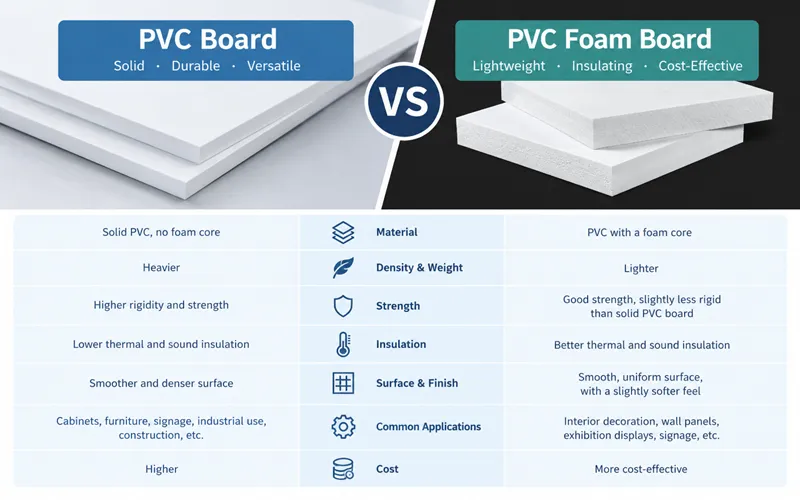
Introduction PVC board and PVC foam board are both versatile plastic materials widely used in construction, interior decoration, furniture, signage, and other applications. Although they share the same PVC base material, their structures, properties, and ideal uses can be quite different.
These two materials are often confused because they have a similar appearance and are both lightweight, durable, moisture-resistant, and easy to process. However, differences in their internal structure and manufacturing process can affect their strength, weight, surface finish, and overall performance.
In this article, we will compare PVC board and PVC foam board in terms of their material, structure, key properties, common applications, and suitable uses. This comparison will help you understand the differences and choose the right PVC material for your specific project.
What Is PVC Board? PVC board is a rigid plastic sheet made primarily from polyvinyl chloride (PVC) . It has a solid and relatively dense structure, providing good strength, dimensional stability, and a smooth, uniform surface. PVC boards are available in different thicknesses, sizes, and colors to meet the requirements of various projects.
Material and Structure PVC board is manufactured from PVC resin combined with additives that improve properties such as durability, stability, and processing performance. Unlike PVC foam board, which has a cellular structure, PVC board generally has a solid or more compact structure , making it suitable for applications that require a stronger and more rigid material.
Key Features of PVC Board Durable: PVC board has good mechanical strength and can withstand regular use and impact.Moisture Resistant: It does not readily absorb water, making it suitable for humid environments and areas exposed to moisture.Easy to Clean: Its smooth surface is easy to wipe and maintain, making it suitable for applications where cleanliness is important.Chemical Resistant: PVC board offers good resistance to many common chemicals, helping maintain its performance in demanding environments.Common Applications PVC board is widely used in construction, interior decoration, furniture, cabinetry, signage, wall cladding, and industrial applications. Its durability, moisture resistance, and easy maintenance make it a practical choice for both indoor and certain outdoor applications.
What Is PVC Foam Board? PVC foam board is a lightweight, rigid sheet material made primarily from polyvinyl chloride (PVC) and foaming agents. Unlike solid PVC board, PVC foam board features a closed-cell foam structure , which reduces its weight while maintaining good rigidity and dimensional stability.
Foam Structure The internal foam structure consists of numerous small, closed cells that are evenly distributed throughout the board. This structure makes PVC foam board significantly lighter than solid PVC materials while providing a good balance of strength, stiffness, and ease of processing.
Key Features of PVC Foam Board Lightweight: The foamed structure significantly reduces the weight of the board, making it easier to handle, transport, and install.Easy to Fabricate: PVC foam board can be easily cut, drilled, routed, shaped, and bonded using common fabrication tools.Moisture Resistant: Its closed-cell structure provides low water absorption, making it suitable for humid environments and applications where moisture resistance is required.Good Insulation: The foam structure provides good thermal and acoustic insulation properties compared with many solid materials.Smooth Surface: PVC foam board has a smooth, uniform surface that is suitable for printing, painting, laminating, and other surface treatments.Common Applications PVC foam board is widely used in signage, advertising displays, interior decoration, furniture, cabinetry, wall panels, exhibition displays, and construction applications. Its lightweight structure, smooth surface, and easy fabrication make it particularly suitable for projects where weight reduction and efficient processing are important.
PVC Board vs PVC Foam Board: Key Differences Although PVC board and PVC foam board are both made primarily from polyvinyl chloride (PVC), their structures and performance characteristics are different. The main difference is that PVC board has a more solid and dense structure, while PVC foam board has a cellular foam structure . This structural difference affects their weight, rigidity, fabrication, insulation properties, and suitable applications.
Material and Structure PVC board generally has a solid or compact structure, giving it good rigidity, strength, and dimensional stability. PVC foam board, on the other hand, contains a closed-cell foam structure created during the manufacturing process. This reduces the material’s density and makes the board considerably lighter.
Weight One of the most noticeable differences is weight. PVC foam board is lighter than solid PVC board because of its internal cellular structure. This makes foam board easier to handle, transport, cut, and install, especially for large panels or projects where weight is an important consideration.
Strength and Rigidity PVC board generally offers higher density and good mechanical strength, making it suitable for applications that require a more rigid and robust material. PVC foam board still provides good rigidity for many applications, but its lower density makes it more suitable for lightweight applications where extreme mechanical strength is not the primary requirement.
Fabrication and Processing Both materials can be cut, drilled, and machined, but PVC foam board is particularly easy to fabricate because of its lightweight and relatively soft structure. It can be easily routed, shaped, bonded, and finished for applications such as signage, displays, furniture, and interior decoration.
Insulation Performance PVC foam board provides better thermal and acoustic insulation than solid PVC board because its cellular structure contains many small air pockets. Therefore, foam board can be a better choice for applications where lightweight construction and insulation performance are important.
Applications PVC board is commonly selected for applications that require durability, rigidity, moisture resistance, and chemical resistance , including construction, furniture, cabinetry, wall cladding, and industrial applications.
PVC foam board is widely used for signage, advertising displays, interior decoration, furniture, exhibition displays, wall panels, and other lightweight applications where easy fabrication and a smooth surface are important.
Overall, neither material is universally better than the other. The right choice depends on the specific requirements of the project, including strength, weight, fabrication method, insulation needs, environment, and application.
PVC Board vs PVC Foam Board: Applications PVC board and PVC foam board can both be used in a wide range of applications, but their different structures and performance characteristics make them better suited to different projects. PVC board is generally preferred for applications requiring higher rigidity and durability, while PVC foam board is often chosen when lightweight construction, easy fabrication, and a smooth surface are important.
Common Applications of PVC Board Construction
Industrial Applications
Wall and Ceiling Systems
Protective Applications
Common Applications of PVC Foam Board Signage and Advertising
Furniture
Interior Decoration
Wall Panels
Display Boards
Printing and Digital Signage
Which Is Better: PVC Board or PVC Foam Board? There is no single answer to whether PVC board or PVC foam board is better. The right choice depends on the specific requirements of your project, including strength, weight, processing needs, surface finish, and application environment .
Choose PVC Board When: Higher Density and Rigidity Are Required
Higher Structural Strength Is Needed
Used for Heavy-Duty or Industrial Applications
Choose PVC Foam Board When: A Lightweight Material Is Required
Easy Cutting, Drilling, and Fabrication Are Important
Used for Signage, Furniture, and Interior Decoration
Good Surface Finishing Performance Is Needed
Ultimately, PVC board is a better choice when strength, density, and rigidity are the main priorities, while PVC foam board is better suited to applications where lightweight construction, easy fabrication, and surface finishing are more important .
How to Choose the Right PVC Board? Choosing the right PVC board depends on more than just comparing material names. The best option should match the specific requirements of your project, including its application, strength, weight, fabrication method, appearance, and budget. Consider the following factors before making a decision.
1. Application Start by identifying how and where the material will be used. Construction and industrial applications may require a denser and more rigid PVC board, while signage, furniture, interior decoration, and display applications may benefit from the lightweight and easy-to-process properties of PVC foam board.
2. Required Strength Consider the level of mechanical strength and rigidity required for the application. If the board needs to withstand higher loads, impacts, or structural stress, a solid PVC board with higher density may be more suitable. For applications where structural strength is less critical, PVC foam board can provide a good balance of rigidity and weight.
3. Weight Requirements Weight can be an important factor for large panels, displays, furniture components, and projects where easy handling is required. PVC foam board is generally lighter because of its cellular structure, making it easier to transport, handle, and install.
4. Machining Requirements Consider how the material will be processed before installation. If the project requires frequent cutting, drilling, routing, shaping, or bonding, PVC foam board can be a convenient option because of its easy fabrication characteristics. Both PVC board and PVC foam board can be machined, but their processing behavior may differ depending on density and thickness.
5. Surface Finish The desired surface appearance and finishing method should also be considered. Both materials can provide a smooth surface, while PVC foam board is particularly suitable for applications involving printing, painting, laminating, or decorative finishing.
6. Budget Finally, consider the overall project budget. Material cost should be evaluated together with processing, transportation, installation, and maintenance costs. A lightweight material such as PVC foam board may help reduce handling and transportation costs, while PVC board may offer better value for applications where higher density and durability are essential.
By considering these factors together, you can select the PVC material that best matches your project’s performance requirements and practical needs. The goal is not to choose the most advanced or strongest material, but to choose the material that provides the right balance of performance, weight, processing, appearance, and cost for your application.
PVC Foam Board for Furniture & Interior Decoration PVC foam board is a versatile material for furniture and interior decoration thanks to its lightweight structure, moisture resistance, smooth surface, and easy fabrication. It can be cut, drilled, routed, shaped, and finished to meet different design and manufacturing requirements.
Furniture Components PVC foam board can be used for various furniture components where a lightweight, moisture-resistant, and easy-to-process material is required. It can be fabricated into panels, partitions, decorative elements, and other customized components.
Cabinet Panels The moisture-resistant properties of PVC foam board make it suitable for cabinet panels and other furniture applications. Its smooth surface can also be laminated, painted, or finished to achieve different decorative effects.
Interior Wall Decoration PVC foam board can be used for interior wall decoration where a clean appearance, easy maintenance, and moisture resistance are important. Its lightweight nature also makes handling and installation more convenient.
Decorative Panels With its smooth and uniform surface, PVC foam board is suitable for decorative panels used in residential, commercial, and other interior spaces. It can be customized through cutting, routing, printing, laminating, and other finishing processes.
Bathroom and Moisture-Prone Areas PVC foam board offers good moisture resistance and does not readily absorb water, making it suitable for selected applications in bathrooms and other moisture-prone interior areas. Proper thickness, installation methods, and application conditions should be considered to ensure long-term performance.
Explore Our PVC Foam Board Looking for a lightweight and versatile material for furniture or interior decoration? Our PVC Foam Board
FAQ About PVC Board and PVC Foam Board Here are some common questions about PVC board and PVC foam board to help you better understand their differences, properties, and applications.
What is the difference between PVC board and PVC foam board? The main difference is their internal structure. PVC board generally has a solid or denser structure, while PVC foam board has a closed-cell foamed structure. As a result, PVC foam board is lighter and easier to fabricate, while solid PVC board generally offers higher density and rigidity.
Is PVC foam board stronger than PVC board? Generally, PVC board has higher density and can provide greater rigidity and mechanical strength. PVC foam board offers good strength-to-weight performance but is mainly preferred when lightweight construction and easy fabrication are more important than maximum structural strength.
Is PVC foam board waterproof? PVC foam board has a closed-cell structure and very low water absorption, giving it good moisture and water resistance. It is suitable for many humid environments, although the overall waterproof performance of an installation also depends on joints, edges, fasteners, and installation methods.
What is PVC foam board used for? PVC foam board is commonly used for signage and advertising, furniture, cabinetry, interior decoration, wall panels, display boards, exhibition displays, and printing applications . Its lightweight structure and smooth surface make it suitable for both functional and decorative applications.
Can PVC foam board be used for furniture? Yes. PVC foam board can be used for furniture components, cabinet panels, partitions, and decorative elements. Its lightweight structure, moisture resistance, smooth surface, and easy fabrication make it a practical option for many furniture applications.
Can PVC foam board be cut and machined? Yes. PVC foam board is easy to cut, drill, route, shape, and bond using common fabrication tools. This makes it suitable for customized furniture components, signage, decorative panels, and other applications that require precise fabrication.
How do I choose between PVC board and PVC foam board? Choose based on your project’s requirements. PVC board is generally more suitable when higher density, rigidity, and mechanical strength are required. PVC foam board is a better choice when lightweight construction, easy machining, moisture resistance, and surface finishing are important. Consider the application, strength, weight, fabrication, surface finish, and budget before making a final decision.
Conclusion PVC board and PVC foam board are both versatile PVC-based materials, but they are designed to meet different application requirements. PVC board features a solid structure, higher density, and good rigidity, making it suitable for applications where strength and durability are important.
In comparison, PVC foam board is lightweight, easy to fabricate, and highly versatile. Its smooth surface, moisture resistance, and easy processing make it a popular choice for signage, furniture, interior decoration, wall panels, and other applications.
Ultimately, the right choice depends on your specific application, required strength, weight, fabrication requirements, surface finish, and budget . Understanding these differences can help you select the PVC material that best fits your project.
Looking for a Reliable PVC Foam Board Manufacturer? Looking for a reliable PVC foam board manufacturer? Contact us for product specifications, samples, and customized solutions.