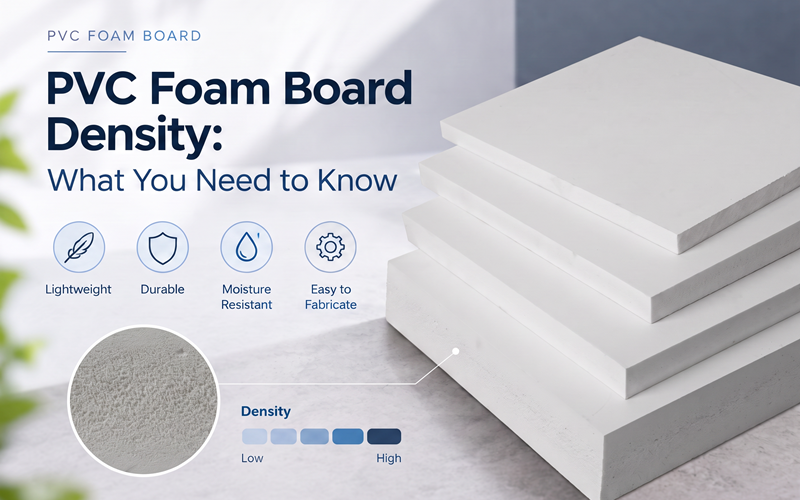
PVC foam board density refers to the mass of the material per unit volume, usually expressed in kg/m³. It is an important specification that can vary depending on the manufacturing process, formulation, and intended application of the board.
Density is one of the key factors to consider when selecting PVC foam board because it directly affects several important properties of the material. A change in density can influence the board’s weight, strength, rigidity, machining performance, and overall suitability for different applications.
Understanding the relationship between density and these properties can help you select the right PVC foam board for your specific project. In this article, we will explain what PVC foam board density means, how different density levels affect material performance, and how to choose the appropriate density for different applications.
What Is PVC Foam Board Density?
Definition of PVC Foam Board Density
PVC foam board density refers to the mass of the material contained within a specific volume. It is an important specification used to describe how compact or lightweight a PVC foam board is.
Density is typically expressed in kilograms per cubic meter (kg/m³). For example, a PVC foam board with a density of 500 kg/m³ contains more material per unit volume than a board with a density of 300 kg/m³. As a result, the higher-density board will generally be heavier when comparing boards of the same size and thickness.
Density is closely related to the weight and physical properties of PVC foam board. In general, lower-density boards are lighter, while higher-density boards tend to provide greater rigidity and material strength.
How Is PVC Foam Board Density Measured?
The basic formula for calculating density is: Density = Weight ÷ Volume
To determine the density of a PVC foam board, the board’s weight and volume are measured. For a rectangular board, the volume can be calculated by multiplying its length × width × thickness. The measured weight is then divided by the calculated volume to obtain the density in kg/m³.
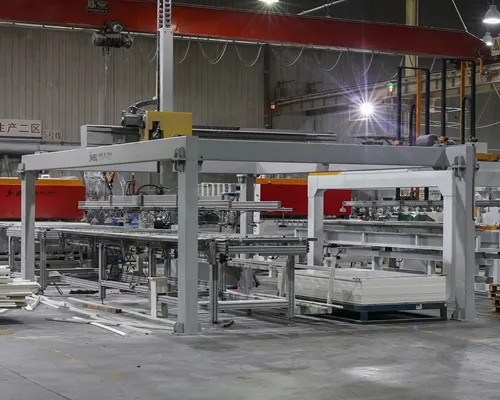
Different manufacturing processes can result in different PVC foam board densities. Factors such as the PVC formulation, type and amount of foaming agent, processing temperature, extrusion conditions, and production parameters can affect the internal cellular structure and the amount of material contained within the board.
Therefore, even PVC foam boards with the same thickness and dimensions may have different densities and performance characteristics depending on how they are manufactured.
Common PVC Foam Board Density Ranges
PVC foam board is available in different density levels to meet the requirements of various applications. In general, density affects the board’s weight, rigidity, strength, and processing characteristics. The appropriate density depends on the intended use and the performance requirements of the project.
Lower-Density PVC Foam Board Lower-density PVC foam board contains more cellular structure and less material per unit volume, making it lightweight and easy to handle. It is commonly used for signage, advertising displays, exhibition boards, and other applications where low weight and easy fabrication are important.
Medium-Density PVC Foam Board Medium-density PVC foam board provides a balance between weight and mechanical performance. It offers good rigidity while remaining relatively lightweight and easy to machine. This makes it suitable for furniture, cabinetry, interior decoration, and wall panel applications.
Higher-Density PVC Foam Board Higher-density PVC foam board contains more material per unit volume and generally provides greater rigidity and strength. It can be considered for construction, cabinet components, industrial applications, and other projects where higher mechanical performance and dimensional stability are required.
It is important to note that density alone does not determine the overall performance of PVC foam board. Factors such as formulation, thickness, cell structure, surface quality, and manufacturing process can also affect the final properties of the board. Therefore, density should be evaluated together with the specific requirements of the application.
How Does Density Affect PVC Foam Board Performance?
The density of PVC foam board can influence several important properties, including weight, strength, rigidity, machining behavior, surface quality, and insulation performance. However, density should not be considered the only factor determining performance. The formulation, cell structure, thickness, and manufacturing process can also affect the final characteristics of the board.
Weight Density has a direct relationship with the weight of PVC foam board. When comparing boards with the same dimensions, a higher-density board will generally weigh more because it contains more material per unit volume.
Lower-density PVC foam board is often preferred for applications where lightweight construction, easy handling, transportation, and installation are important. This makes it suitable for signage, displays, and other applications where reducing overall weight is a priority.
Strength and Rigidity Density can affect the rigidity and mechanical performance of PVC foam board. In general, higher-density boards tend to provide greater rigidity and better resistance to mechanical stress than lower-density boards of the same thickness.
For applications requiring greater dimensional stability or structural performance, a higher-density PVC foam board may be more appropriate. Lower-density boards, meanwhile, can provide a useful balance of weight and rigidity for applications where maximum strength is not required.
Machining and Fabrication PVC foam board is generally easy to fabricate, but density can influence the machining experience and the behavior of the material during processing.
Common fabrication methods include:
Cutting: PVC foam board can be cut into different sizes and shapes using suitable tools. Drilling: Holes can be drilled for fasteners, fittings, and other components. Routing: Routing can be used to create grooves, edges, profiles, and decorative details. CNC Machining: CNC equipment can be used for more precise cutting, routing, engraving, and customized shapes. Lower-density boards are generally easier and faster to machine because less material needs to be removed. Higher-density boards can provide cleaner edges and greater dimensional stability during certain machining operations, although they may require somewhat more cutting effort.
Surface Quality Density can also influence the surface characteristics of PVC foam board. Higher-density boards may provide a more compact and stable surface, which can be beneficial for applications requiring consistent finishing and dimensional stability.
A smooth and uniform surface is important for processes such as digital printing, screen printing, laminating, painting, and decorative finishing. However, surface quality also depends heavily on the board’s manufacturing process, formulation, and surface treatment rather than density alone.
Thermal and Acoustic Performance The cellular structure of PVC foam board provides insulation properties by incorporating numerous small air-filled cells within the material. These cells can help reduce heat transfer and contribute to thermal insulation performance.
Density can influence the balance between the amount of solid material and the cellular structure. Lower-density boards generally contain a greater proportion of void space, while higher-density boards contain more material per unit volume. As a result, insulation performance can vary with density, but the relationship is not simply that higher or lower density is always better.
For projects where thermal or acoustic performance is important, it is best to evaluate the specific density, cell structure, thickness, and tested performance data of the PVC foam board rather than relying on density alone.
High-Density vs Low-Density PVC Foam Board
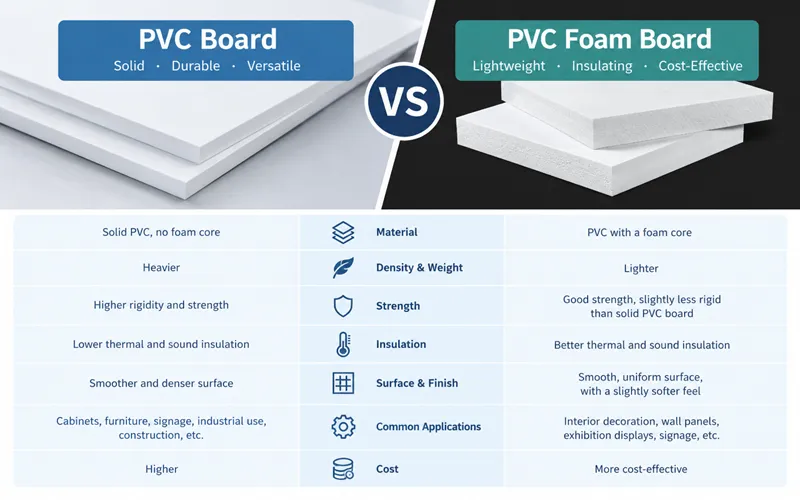
Low-density and high-density PVC foam boards are designed to meet different performance requirements. The main differences can be seen in weight, rigidity, strength, handling, and typical applications. Low-density PVC foam board focuses more on weight reduction and easy handling, while high-density PVC foam board generally provides greater rigidity and mechanical strength.
Low-density PVC foam board is commonly selected for signage, advertising displays, exhibition boards, and other lightweight applications where easy handling and fabrication are important.
High-density PVC foam board is generally more suitable for applications requiring greater rigidity, strength, and dimensional stability, such as furniture, cabinet components, construction-related applications, and other demanding projects.
The actual performance of a PVC foam board depends not only on density but also on factors such as thickness, formulation, cell structure, surface quality, and manufacturing process. Therefore, density should be evaluated together with the specific requirements of the application.
What Density Should You Choose for PVC Foam Board? The right PVC foam board density depends on the specific application and performance requirements. A higher density does not always mean a better choice. Instead, factors such as weight, rigidity, machining, moisture resistance, surface requirements, and board thickness should be considered together.
For Signage and Advertising For signage and advertising applications, a lightweight PVC foam board is often preferred because it is easy to handle, cut, and install. Its smooth and uniform surface also makes it suitable for printing and other graphic applications.
Key considerations include:
Lightweight for easier handling and installation Easy to cut and fabricate into different shapes Easy to install for indoor and temporary displays Smooth surface suitable for printing and graphic applications For Furniture and Cabinets Furniture and cabinet applications generally require a good balance between weight, rigidity, and machinability. A medium- to higher-density PVC foam board can provide better rigidity while still maintaining good machining performance.
It can be used for cabinet panels, furniture components, partitions, and other fabricated parts.
Key considerations include:
Better rigidity for furniture and cabinet components Good machining performance for cutting, drilling, and routing Suitable for cabinet panels and furniture components A good balance between structural performance and weight For Interior Decoration For interior decoration , lightweight and easy-to-fabricate materials are often preferred. PVC foam board offers moisture resistance and can be easily cut, drilled, routed, or shaped for different decorative applications.
It can be used for wall panels, decorative panels, partitions, and other interior finishing applications.
Key considerations include:
Lightweight for easier handling Moisture resistant for suitable interior environments Easy to fabricate and install Suitable for wall panels and decorative applications For Construction Applications Construction applications may require greater strength, rigidity, and dimensional stability. In these cases, density should be evaluated together with board thickness rather than considered on its own.
A thicker board with an appropriate density may provide the required performance without simply selecting the highest-density material available. The final choice should be based on the specific project requirements, including mechanical load, installation method, environmental conditions, and required service performance.
Key considerations include:
Consider strength and rigidity requirements Evaluate board thickness and density together Consider the expected load and installation conditions Select the appropriate specification according to project requirements
Conclusion
PVC foam board density is an important factor to consider when selecting the right material for a specific application. It affects the board’s weight and can influence important performance characteristics such as rigidity, strength, and machining performance.
Three key points to remember are:
Density affects the weight and performance of PVC foam board. Higher density generally provides greater rigidity and strength. The right density depends on the application, board thickness, machining requirements, and overall performance needs. Rather than simply choosing the highest-density PVC foam board, it is important to consider the complete requirements of your project. Selecting the appropriate combination of density, thickness, and material properties can help achieve the desired balance of performance, weight, and cost.
Looking for PVC foam board with the right density for your application? Contact us for specifications, samples, and customized solutions.